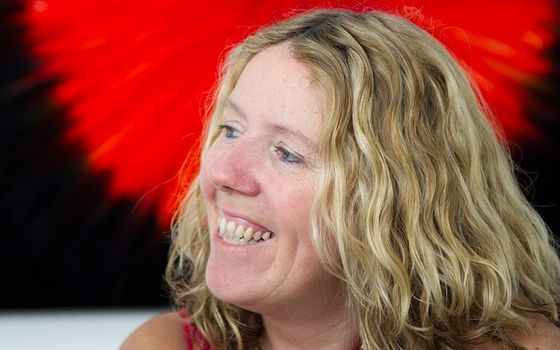
Deirdre Kinahan is one of Ireland’s leading playwrights, known for her work on a series of productions including Melody and Halcyon Days.
Deirdre will bring her latest work Spinning to the Dublin Theatre Festival with Fishamble: The New Play Company from October 1st to 12th. For more information, see www.dublintheatrefestival.com.
During rehearsals for the run, she took a little time out to talk to Her.ie about what it’s really like to be a playwright.
So, tell us a little about what you do…
I am a playwright so I write plays for the stage and occasionally for radio. I am also currently writing for film. I am generally working on two or three projects simultaneously… switching through stories and scenarios but also making notes for new ideas or new plays I might write down the line.
But I suppose writing is really only a part of what I do. As a freelance artist, I am constantly hustling for work or hustling to get work staged. It can be a frustrating but also very rewarding part of the job. I am constantly dreaming up projects for festivals or theatres and often work in collaboration with other writers or theatre practitioners in creating an event or delivering on an idea.
For example, when the local arts office asked me to get involved in a celebration of the centenary of Mary Lavin, I went off and read some of her short stories, got a team together and devised a theatrical presentation of some of her work. It was very successful locally in Meath so I then worked in collaboration with the Arts Office to move the production to Dublin and to feature it in a major literary festival.
I write plays that are produced nationally and internationally so I spend a fair bit of time travelling, keying in with other theatres and production companies, building relationships and talking about Irish theatre and international trends in writing.
I also go to see plays constantly and read plays I cannot travel to see. This is hugely important to me, not only because I just love going to the theatre but also in terms of inspiration and artistic exchange. I also try to engage with the artistic sector, participating in discussions on the future of theatre and giving time to institutions working to keep art at the core of social activity.
How did you get to your current position?
I went to drama school as a kid and just loved it, always dreaming of being an actor. In my twenties, I travelled for a few years and when I came home I decided ‘right, now it’s time to go into theatre’ but I wasn’t sure how. So, myself and a pal but some money together and staged a play in the Crypt of Dublin Castle.
The play went well so we staged another and another. We called ourselves Tall Tales Theatre Company and threw ourselves into making theatre on a shoestring but eventually began to attract some funding from the Arts Council. It was probably five years in before I made a penny out of writing/acting and producing but I found my feet as a writer and grew in confidence and skill with the company.
Tall Tales’ final production was my play Halcyon Days in 2012, which sold out at the Dublin Theatre Festival and won a Fringe First in Edinburgh. I’m out on my own now but fifteen years of experience producing and writing has set me up very well.
What is your typical working day?
There are not too many typical working days, life is very dynamic. I collaborate with a lot of people to get plays on stage: directors, actors, choreographers, producers, publicists, publishers.
As I said, I travel a lot and spend a fair bit of time at meetings plotting or dreaming or planning how to raise funds for a particular project. I generally write three or four days a week in four-hour spats and then run away to the Tyrone Guthrie Centre or a little writing house I have access to in Meath for a week at a time to delve deep into a play.
I have two daughters at school so when I’m at home, I will write from 10am to 2pm and then be around for dinner/homework/sports/drama with them. When I’m away, my husband keeps the house together and I write, write and write. It’s great to totally submerge myself into something, then I do re-writes at home. I usually go to Dublin one day a week for meetings and to see plays/film.

Why did you choose your current career?
I love the theatre. I think it is a magical and truly important place. I believe it can transport us into any world and any experience. It helps us understand ourselves and creates empathy. A murderer has a story, as does a queen or a barrister or a prostitute. We can begin to understand them or the decisions they make if it is presented to us through theatre… it allows us to explore the chaos and the tenderness, the cruelty and the potential within ourselves and every human being in the safely of a black box. It provides for imagination and huge emotion. It opens our minds and educates. It thrills. I have always wanted to be a part of it.
What are the biggest challenges you face in your career?
Maintaining that career. Cuts in investment from the Irish Government have wreaked havoc on the arts community. It is increasingly difficult to finance theatre productions and playwrights can only thrive through having their work produced.
What are the most rewarding aspects?
To feel really engaged in the world. To be able to write about contemporary issues and emotions and scenarios that deeply affect us all. To see the effect that that writing can have on an audience… to see them laugh or cry or question their own previously held notions or beliefs.
To work in a place I truly love.
Could you ever see your work taking you away from Ireland?
My work takes me away from Ireland all the time. I write for theatres in London and New York as well as at home but I don’t plan on moving house and home. My inspiration is the people around me, it is the Irish condition and Irish life. I don’t imagine ever leaving Ireland permanently.
What is the best piece of advice that you’ve been given?
Have dogged self-belief and don’t take yourself too seriously.
What has been the one ‘pinch me’ moment of your career so far?
My London debut with Moment at the Bush Theatre… it was a five star hit in a city with an incredible standard of theatre.
What do you think is the biggest misconception about what you do?
That writing for theatre is an isolated endeavour – the notion that at you just write a play and hand it over. Being a playwright is an incredibly collaborative experience and the rigour and craft required is immense… We write, write, rewrite, write and rewrite… every word matters, every breath BUT it is only when directors, creatives, actors and audience engage that the magic happens. Theatre cannot happen without collaboration.
What is the biggest mistake that you think people in your chosen sector make?
Giving up. No one is going to make your career happen. Talent is a given… it takes more than talent to make a successful playwright. You have to be true to your creative impulse, dogged in pursuing production and always open to opportunity improvement and new inspiration.
Describe what you want to achieve in your career with one sentence.
I want to write plays that really affect my audience, that shift their world view and help create empathy for fellow human beings.