“I saw the best minds of my generation destroyed by madness, starving hysterical naked.” There is no doubt about it, the first line of Allen Ginsberg’s Howl will literally floor you. One of the central writers of the Beat movement, Ginsberg dedicated his Howl and Other Poems to an elusive Lucien Carr, a man who asked to be removed from the dedication and continued to live a quiet, uneventful life.
But that life wasn’t always so uneventful. The fact that there is forever an interest in bringing stories about the Beats, the poets who defined a generation, to the big screen is no surprise, the true story behind the poets and authors is so unbelievable it almost seems like it is entirely scripted. Although it lends a great deal of artistic licence here in terms of their actual relationship, the essential story is true.

Do not get us wrong, there is no need for a prior knowledge of the Beat movement to watch Kill Your Darlings, but the background to one of the most famous writers of the 20th century will certainly give the piece some depth.
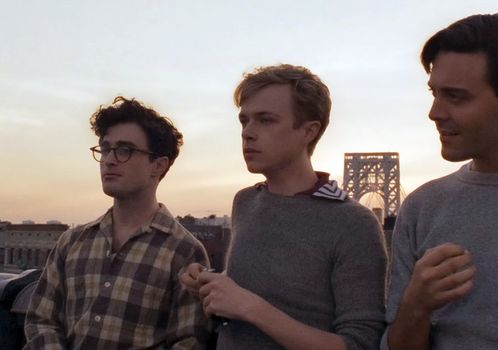
Kill Your Darlings introduces us to Ginsberg initially, a younger Ginsberg, a Ginsberg who was much less sure of himself than he was in later life. With a difficult family situation constantly to the fore of his mind, Ginsberg departs for college where he first encounters the enigmatic Lucien Carr, a student of some wealth who lives according to his own rules.
Carr introduces Ginsberg to a life he had not known, a freedom of his mind, introductions to those who have similar interests to him, and, most importantly, the beginning of his career. However, the further Ginsberg gets drawn into the world of Carr, the more he realises he is beyond his depth and control. When a murder shatters the group, Ginsberg begins to question where his loyalties and morals lie.
Kill Your Darlings won’t exactly change your life, but it is a worthy adaptation of the beginnings of the Beat movement. This is where Ginsberg truly began to find his voice, the film is quick to suggest that this discovery lies with Lucien Carr alone, his attraction to him paramount for everything that follows. Director John Krokidas manages to capture the essentials of the era while also painting a potrait of its members and simultaneously making them interesting characters, which is no mean feat.
For the first time, Radcliffe begins to shake off the ghost of Harry Potter, a role that may be destined to stay with him for the rest of his life. Once the character of Ginsberg begins to develop, so does Radcliffe’s acting, something we never thought we would report. Ben Foster also gives a marvellous performance as the loner William S. Burroughs, while Elizabeth Olsen is, of course, on form as the long-suffering girlfriend of Jack Kerouac.

The stand-out performance here is, without a shadow of a doubt, Dane DeHaan, who, as Lucien Carr, manages to embody everything about his character, elusiveness, sensitivity, intimidation, lust, presence, there is no facet of Carr’s personality that we feel is left unexplored.
The story itself is one of those unsolved mysteries that will forever be committed to the ages, but the actual murder is incidental compared to the relationships we begin to see forming. Although at times the film can seem very much “holier than thou”, it creates a world you perfectly imagined, the life of a curious writer.
Well worth a watch for its performances alone, and hopefully the subsequent research on the characters, Kill Your Darlings is certainly an interesting piece.