Over the last few years we have been told that Irish film is constantly evolving and evolving to a level that it hasn’t reached before, but the reports are true. Irish film has now become something that we can be infinitely proud of with amazing casts, brilliant directors but most importantly, scripts that give actors and actresses an opportunity to exercise their acting chops while simultaneously dealing with some pretty important issues in society. Recession, abuse, health and marriage, no topic has been deemed too serious for representation on the big screen, but Irish film was beginning to end up in a rut, constantly depending on these particular themes instead of reaching a point where we can move past them and see them in a different light. This is not to say that any of these issues should ever be ignored, rather their representation needed to change.
Thankfully, post-modern Ireland is certainly been represented on the big screen. Gone are the days where many felt the need to tiptoe around subjects, now we are facing these demons head on. Granted, there will always be criticism of the representation of this little nation on screen, but we, as a country, always feel the need to be understood. Occasionally, how we are depicted on the big screen by those living outside the country can be jarring; the accents aren’t right, many don’t seem to understand that we don’t head to the end of rainbows to try to find crocks of gold and perhaps most importantly, although we are partial to the odd beverage, we’re not exactly raving alcoholics. Well, most of the time.
Yet somehow, John Michael McDonagh has managed to “get” us. Granted, he actually spent a good portion of his life here in Ireland, McDonagh has become this brilliant lens through which we can see ourselves, both the view from abroad and from at home, which is not the most common. He gets our dry humour, he understands our concerns, and yet, with Calvary, he still manages to treat the most serious of topics with just that edge of humour that’s needed.
McDonagh says the idea for Calvary came to him while drinking in a pub with the cast from The Guard. Discussing the situation with the church and clerical abuse, McDonagh said he understood that not all priests were bad and he wanted to make a film about a good priest. Calvary was born.

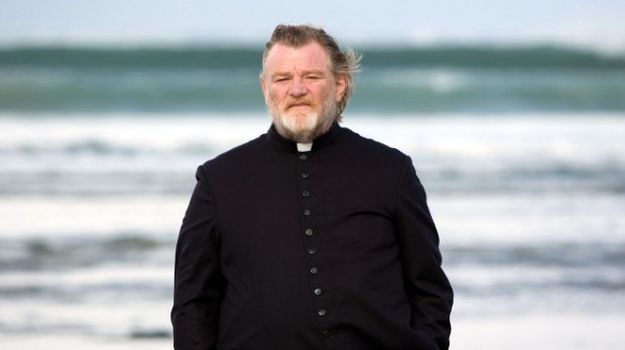
Revolving around that one good priest, Calvary tells the story of Father James Lavelle who lives in a sleepy village where he knows everyone’s business and everyone knows his. However, during confession, a threat is made on his life by one of his congregation who tells Lavelle he must try to tie up his affairs in just a few days before an attempt will be made on his life. Father Lavelle spends his time trying to continue his work in the parish while also attempting to figure out who has issued this threat.
This isn’t quite as easy as you may think. Although Lavelle lives a virtuous life and is a help to all who need him in his parish, there are quite a few colourful people who are not the fondest of the lovable priest. Some provide comedy and laughs, others will slightly break your heart, all are part of his mission.
Calvary is just wonderful, there are no two ways about it. With the deeply haunting subject matter, it would be easy to fall into the same loops as Irish films have before, but it becomes so much more than that; you will begin to almost feel sorry that a man like Lavelle is really losing his place in modern society. He offers counsel and solace, yet there are those who are not religious and who find fault with the institution he comes from, rather from the work he does himself.
Nearly everything works here, the script is absolutely immaculate. Although this is particularly dark subject matter, there are still occasions when you can breathe a sigh of relief and laugh. The characters are wonderful and entirely believable, some a little left of centre, but brilliantly written with troubling back stories of their own. The butcher whose wife is cheating on him, the lonely boy who wants his life to be something amazing, the troubled daughter; the list is endless.
In terms of performances, Gleeson, of course, owns the entire affair. His sombre nature and his wonderfully sweet character would win over any disbeliever. He is the great pillar of strength in his community, yet simultaneously the broken man, a balance he displays quite beautifully. The character was written for him, there is no one else who could play this role to this level. However, that is not to say the rest of the cast are not brilliant, Killian Scott, Aidan Gillen, Domhnall Gleeson and Chris O’Dowd. This is literally the epitome of Irish talent and there are none better.
Also, make sure you see this in the cinema. McDonagh has a particular talent at making this country look as beautiful on screen as it is in reality.
We wish there were more Irish films like this.