Search icon

Life

29th Mar 2016

5 Things That Are Probably Already On Mars As We Speak

Ciara Knight

Mars, am I right? (The planet, not the chocolate bar).

It’s only a matter of time until we can all start moving to Mars. I can’t wait, but I’m concerned about what I should pack.

After some extensive research and statistical analysis, here is what is likely to be waiting for us on Mars when we eventually get there.

1. Volkswagen Golfs

IN SPACE - JULY 16: In this handout image supplied by the European Space Agency (ESA) on July 16, 2008, The Echus Chasma, one of the largest water source regions on Mars, is pictured from ESA's Mars Express. The data was acquired on September 25, 2005. An impressive cliff, up to 4000 m high, is located in the eastern part of Echus Chasma. Gigantic water falls may once have plunged over these cliffs on to the valley floor. The remarkably smooth valley floor was later flooded by basaltic lava. (Photo by ESA via Getty Images)

Based on the Earth numbers, there are statistically ten billion Volkswagen Golfs waiting for us on Mars currently. It’s a popular car on any planet and by Christ the basics love it.


2. Bobby Pins

HALE CRATER, MARS - UNSPECIFIED DATE: In this handout provided by NASA's Mars Reconnaissance Orbiter, dark, narrow streaks on the slopes of Hale Crater are inferred to be formed by seasonal flow of water on surface of present-day Mars. These dark features on the slopes are called "recurring slope lineae" or RSL. Scientists reported on September 28, 2015 using observations with the Compact Reconnaissance Imaging Spectrometer on the same orbiter detected hydrated salts on these slopes at Hale Crater, corroborating the hypothesis that the streaks are formed by briny liquid water. (Photo by NASA/JPL-Caltech/Univ. of Arizona via Getty Images)

You can never find one when you need one, but rest assured, Mars is littered with hairclips, or ‘slides’, as the more adorable of us call them.


3. Pigeons

IN SPACE - JULY 16: In this handout image supplied by the European Space Agency (ESA) on July 16, 2008, The Echus Chasma, one of the largest water source regions on Mars, is pictured from ESA's Mars Express. The data was acquired on September 25, 2005. An impressive cliff, up to 4000 m high, is located in the eastern part of Echus Chasma. Gigantic water falls may once have plunged over these cliffs on to the valley floor. The remarkably smooth valley floor was later flooded by basaltic lava. (Photo by ESA via Getty Images)

These brave little freaks are everywhere and they’re getting braver every day. Mars is called the red planet because it is furious with all the pigeons inhabiting it currently.


4. Katie Hopkins’ Horrible Opinions

IN SPACE - JULY 16: In this handout image supplied by the European Space Agency (ESA) on July 16, 2008, The Echus Chasma, one of the largest water source regions on Mars, is pictured from ESA's Mars Express. This ortho-image was rectified using elevation data derived from a high-resolution Digital Terrain Model, or DTM (obtained from HRSC data), such that distortions introduced during imaging are corrected. Such an image can be used to derive maps. Elevation data from the DTM has been colour-coded and overlain on the ortho-image so that elevation data and the image itself are displayed in a single scene. The scale is in metres. (Photo by ESA via Getty Images)

If you’re leaving Earth to escape these horrendous opinions, you may as well stay put. Her toxic words have spread as far as Mars and we’ve received unconfirmed reports that the aliens are as fed up with her as we are.


5. Arts Degrees

IN SPACE - JULY 16: In this handout image supplied by the European Space Agency (ESA) on July 16, 2008, The Echus Chasma, one of the largest water source regions on Mars, is pictured from ESA's Mars Express. The data was acquired on September 25, 2005. The dark material shows a network of light-coloured, incised valleys that look similar to drainage networks known on Earth. It is still debated whether the valleys originate from precipitation, groundwater springs or liquid or magma flows on the surface. (Photo by ESA via Getty Images)

Now officially more popular than body hair, Mars is littered with Arts Degrees. Finding the going a bit tough in college? Not to worry, simply jet off to Mars for an afternoon and grab yourself this prestigious award.


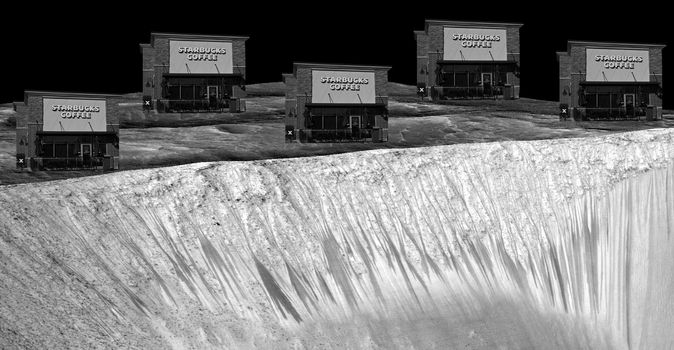
6. Starbucks

HALE CRATER, MARS - UNSPECIFIED DATE: In this handout provided by NASA's Mars Reconnaissance Orbiter, dark, narrow streaks on the slopes of Garni Crater are inferred to be formed by seasonal flow of water on surface of present-day Mars. These dark features on the slopes are called "recurring slope lineae" or RSL. Scientists reported on September 28, 2015 using observations with the Compact Reconnaissance Imaging Spectrometer on the same orbiter detected hydrated salts on these slopes at Hale Crater, corroborating the hypothesis that the streaks are formed by briny liquid water. (Photo by NASA/JPL-Caltech/Univ. of Arizona via Getty Images)

Mars was barely discovered and there was already 35 Starbucks doing a trade up there. It’s comforting to know that when we finally move in, there’ll be soy decaf skinny lattes on tap.