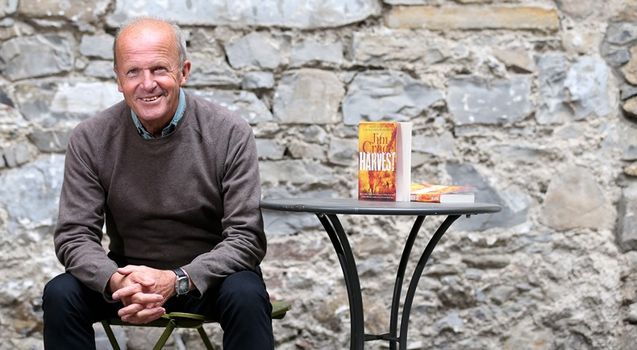
Jim Crace’s Harvest was the winner of this year’s International IMPAC DUBLIN Literary Award.
Earlier this week Crace bagged the coveted award which is organised by Dublin City Council and receives nominations from public libraries in cities all over the world.
Harvest is set in a green corner of England. It is a story about the last days of a village and the death of a way of life.
We spoke with the author himself about the novel and whether it’s actually his last…
How does this compare to awards you have won or been shortlisted for in the past?
When people say award-winning author what they actually mean is that this writer doesn’t sell any books! But the difference with this award is that the IMPAC award does have impact. I think it, together with the Booker, has a status among readers that is as high as its status among writers and actually I’m going to find in Ireland an audience I never had before. Obviously, I’ve always done respectfully well in Ireland, I’m expecting much better things now. Any writer that pretends they don’t want readers would be kidding you.
Where did the concept for Harvest come from?
In the United Kingdom we have these things called ridge and furrows which are the signs in the landscape of where the land was last ploughed. Every single place in the world has got something in the landscape of land being stolen from farmers, from peasants, from people who worked it for years.
In England ridge and furrows are beautiful marks in the landscape and if you only look at the beauty, you think that’s all that’s there but actually, it’s dispossession and I think it’s those two things together – beauty and dispossession – which is what this novel is about.
It’s about landscape and politics, beauty and dispossession. And the fact that every nation in the world, right to this very day, there’s somebody, in the name of money, is stealing land off farmers that have had it in their families for generations – so that’s what the novel is about.

Do you find it challenging to deal with these universal themes?
Well you don’t always know what you’ve got until you’ve got it. There’s a process of writing books and you don’t know how serious they are or the variations until afterwards, until they’re finished. Then you can say, ‘Oh, I always intended that book to be about that’.
To be honest, I write blindly, hoping for the best. And sometimes a book under delivers and sometimes a book over delivers. I have to say that Harvest has been such a fortunate book in the regard that people have taken to it. One of the weird things about it is that out of all my books, it is the most English landscape but it’s reverberated the whole way around the world.
You never know. It’s a game of chance writing novels. It’s a mistake to congratulate yourself too much because very often, the success of the novel is in the lap of the Gods and not in the hands of the writer.
Is your work autobiographical?
No writer is not autobiographical. There has to be something in the book that reflects you as a writer. But my books aren’t autobiographical in the sense that an adulterer writes a book about adultery or a university lecturer sets their books in a university.
That’s not the type I do. I’m a much more traditional writer in that regard. Clearly you can tell a lot about me from my books. You can tell that I am interested in natural history, you can tell I’m a walker and I love landscape and am interested in the metaphors of landscape and you can tell that I’m left wing. You always leave a trace – on whatever you do.
You have previously suggested that this is your last book – is that true?
It will be my last contracted book. I don’t work for anybody any more. I’m not on contract with any publishing house so if I want to write a novel, I can. I don’t owe it to anybody. No one is going to be breathing down my neck. I don’t owe any money to anybody. I’ve taken no advances.
If I never write another book – fine. If I write another book that is not convincing, I don’t have to publish it so, basically if I do write another book you’ll only know about it if I determine it to be a really good book.

Are there other contemporary authors who you admire and/or read?
There are a number of writers that I like but I read fewer and fewer novels. I trade in fiction, so I can’t read fiction. If I’m reading someone’s novel I read it like a professional – I’m questioning every sentence, I’m doubting every metaphor, I’m wondering about the punctuation. It’s not a lot of fun for me to read novels.
I read a lot of natural history writing and books about birds and such, that’s my pleasure I have to say. The last thing I want to do after a day in front of a blank computer screen is to sit down and read a book, which is what my wife would want to do. She wants to spend her causal hours reading, I want to spend my casual hours mowing the lawn.
What advice would you give to younger writers?
My best advice is take risks. There are plenty of brilliant writers, who won’t take risks and will write perfect little pieces and you’ll not find a blemish. Now would you rather read that book or a book that’s full of blemishes but has taken on the world – that has taken massive risks, has been adventurous?
We all want to read that second book. So take risks. Do things that almost seem beyond your capabilities – if you triumph, that will be a real achievement.