One of the enduring stereotypes associated with women is that female comedians are not funny but Ireland’s growing stable of stars is certainly showing that this is not the case.
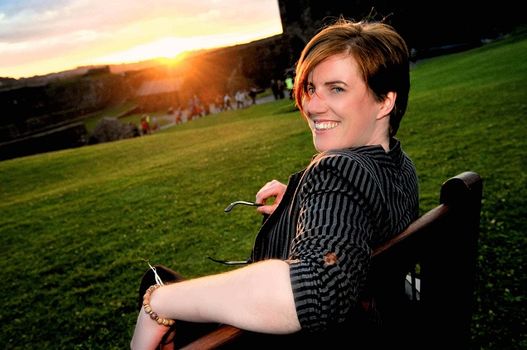
Breda Larkin is one such comedian and has recently embarked on a comprehensive tour of the small towns of Ireland with her one-woman show The Word Of Breda. The show will include a humourous journey through Breda’s experience of growing up in the country, figuring our her sexuality and finding her place in the world.
So, as she began her journey, we had a quick chat about what it’s really like to be a female comedian.
When did you decide that comedy was the career for you?
I did always kind of want to be a stand-up and when I was travelling, people often said ‘you should be a comedian’ but I always thought ‘oh no, that’s impossible’. I just didn’t think it could be a possible career.
When I came back, I happened to meet this man on the street who was handing out flyers for a comedy club in Galway and he said ‘sure, give it a go for five minutes’ so I did that. It was petrifying but I signed up for a second one, not realising that I was going to be between Jason Byrne and Carol Tobin! I was thrown in at the deep end!
That was about six years ago and while I really enjoyed it, I felt like I wasn’t ready. I wasn’t really myself, I still hadn’t come out and I felt a bit uncomfortable. So I went off and did a drama course with the idea of doing drama therapy and to be honest, that turned out to be a great course for comedians as it’s all about improv, how to engage with the audience, how to work on your voice etc. So by the end of it, I had written my own show and it was funny so I decided to put in into the stand-up genre. I’ve been doing it since then and I think the one-woman show is great because you get all the stage time and write new material all the time in your head.
Is it hard to break into the comedy circuit in Ireland?
I think it is hard. When I did it originally, there seemed to be a lot less people doing it. When I came back almost a year ago, I found it very hard to get a slot, even five minutes in a comedy club in Dublin. I was surprised by that. Maybe it’s the recession, people are trying new things or maybe there’s less comedy clubs that there was.
There’s a lot of amateur comedians out there at the moment. I think the scene is changing a bit, there’s a lot more room for new comedy. Ireland is still relatively new to the genre of stand-up. In England, a lot more older people go to comedy whereas in Ireland, I think they’re more likely to play music or go to a concert for entertainment. In parts of England, you’ll have a comedy club on every corner.
Comedy would have traditionally have been a very male-dominated environment. Has that been an issue for you?
It’s like that old saying ‘you have to work twice as hard to get halfway’. It’s a bit of a boys club because it’s always been that kind of ‘working class lads’ thing to do. There’s a lot more men so women are a bit of a novelty.
That’s why I like to do the one-woman show. The circuit can be a very competitive environment and I think biologically women tend to be a bit more internalised. It’s the same with the television panel shows, it’s not a great environment for women, I’d love to see a show with three women and a token guy and see how he reacts in their environment. People still say that women aren’t funny but that’s ridiculous. That’s like saying that every man is ugly, it’s just generalising.
Why did you decide to tour the show around some of Ireland’s less-frequented spots?
I was chatting to my friend and she’s a real ‘yes’ woman. Any time I’m saying ‘oh I’d love to do that’, she goes ‘why don’t you!’.
I liked the idea of going around Ireland. I live in Ballinasloe and my town is kinda dying a bit. Everyone always calls their own town ‘a sh*thole so I’m always wondering why that is. I wanted to go and visit the towns and then ask people what their favourite thing was about their town, their least favourite, what makes it unique. I have a series of questions to ask people along the way. It’s an adventure. It’s about making people excited about their own towns and talk to people about how Ireland is changing.
What can people expect from the show?
It’s autobiographical and it’s about growing up as a farmer’s daughter in Ballinasloe. Gender would be one of the main themes as when I was growing up, I always wanted to be a boy because I felt like they had more freedom than girls. I looked up to strong women like my mother and Queen Maeve and I love being a woman now, I appreciate what that brings. There’s songs and music and because I have a twin sister called Ella (Irish for other), who was much more girly that I was, we use that as a source of comedy also. It’s a coming of age story and goes through my realisation that I was a lesbian in my early 20s. Afterwards I was pretty lost so it’s about finding yourself and becoming who you are.
The tour is all about trying to meet the people of Ireland, I’m interested in seeing how the country has changed. I’m also looking forward to seeing how people react to seeing a out female comedian. I don’t hide the fact that I’m gay, I’m out and proud at this stage. Ireland is a changing country that way so it’s exciting. I’m a tiny bit apprehensive but I think that with Pantigate and the Eurovision, people are a lot more open to it now. The message is just that you have to follow your own truth.
For more information and a full list of performances on the 32-date Breda’s Pilgrimage tour, see www.thewordofbreda.com or follow Breda’s journey on Twitter at #bredaspilgrimage.